Reflections on Personal Photography and the Family Archive: The Fred O. Scroggs Collection
A reflection on personal photography practices

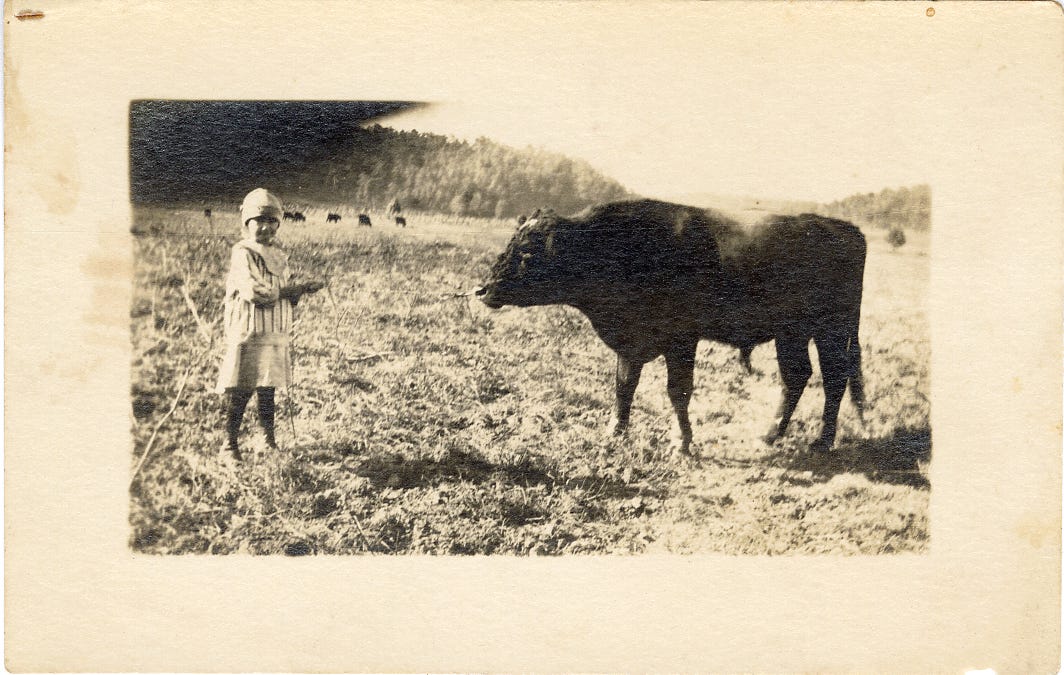
The Fred O. Scroggs collection is held in the John C. Campbell Folk School Fain Archives. It contains hundreds of items, including artwork, genealogy documents, folklore, maps, newspaper clippings, postcards, photographs, and much more. Most materials in the collection are by or about Fred O. Scroggs, although there are also documents he collected from earlier periods, as well as others created and gathered by his siblings or children. During Maya’s time working in the Fain Archives, she scanned and digitized Fred O. Scroggs’ 490 photographic prints and negatives.
Perhaps a fading vestige of the past, photograph albums were, for more than a century, essential to family storytelling and the construction of personal identity: they were gestures of shared history and community. Family albums first became popular in the U.S. in the 1860s following technological innovations in photographic reproducibility. These early albums often included carte-de-visite portraits: photographic cards traded with family and friends, depicting family members as well as celebrities. With the introduction of the Kodak camera in the late 1800s, the family album became increasingly widespread, adopting a more personal, narrative style.
Not intended as historical documents, personal photo albums are instead collections of memory fragments, catalogs of references to past realities. They are seeds from which stories live, grow, and are retold, scaffolding personal history and identity and building belonging.
It can be difficult to retain the same sense of meaning when personal photographs enter the institutional archive and are cemented into historical records. What does the photograph become without the backdrop of personal memory? And to whom are these images speaking?
To a stranger without the context of lived experience, the family photo album can begin to seem like a repeating pattern of cultural and social conventions: travel photos, baby pictures, family portraits, wedding photos, etc. But looking from the outside in offers a distinct perspective on the family album, relying on our ability to see commonality and contextualize larger cultural experiences within this assemblage of unfamiliar faces. Even if the memories contained in these photographs are personal, the act of remembering can be collective. In an environment like the John C. Campbell Folk School, these archives remain within an active web of community members who continue to be interested in their history. This nesting of archival objects within the community keeps history tethered to memory.
When Fred O. Scroggs captured, collected, and curated the photographs held within his personal albums, now housed in the John C. Campbell Folk School’s Fain Archives, he often considered the potential and unknowable viewers of the future. On the cover of a folder of documents relating to his own family history, he wrote:
During the past three winter seasons, from time to time, I have spent several hours trying to get some of this material filed so that it may be used in the future. Some of the work has been rather slow, such as getting dates, etc. It is my hope that my family keep these records intact and in some safe way so that they can be available to our future generations and other interested persons. – Fred O Scroggs, Dec. 9. 1965
The Fred O. Scroggs photo collection includes his own family albums, earlier portraits and documents from his ancestors, and photographs related to his personal interests in craft and mineralogy. Born in 1891 in Brasstown, NC, he owned many businesses in the area, most notably a general store, and was widely considered a leader in the community. He played an important role in the founding of the Folk School in Brasstown, organizing community support for the school and often serving as a mediator between the school and the town in its early days.
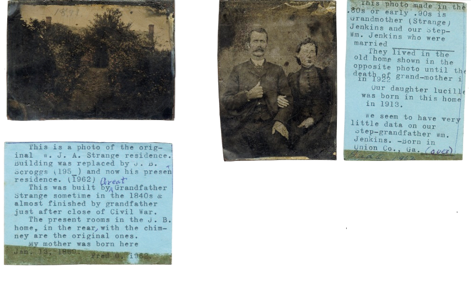
His photographic archive contains sub-collections of travel albums and family portraits, many of which are accompanied by typed or handwritten notes about their contents. Most of Fred’s annotations are written in retrospect: an organizational procedure sometimes completed years after the photograph was taken.
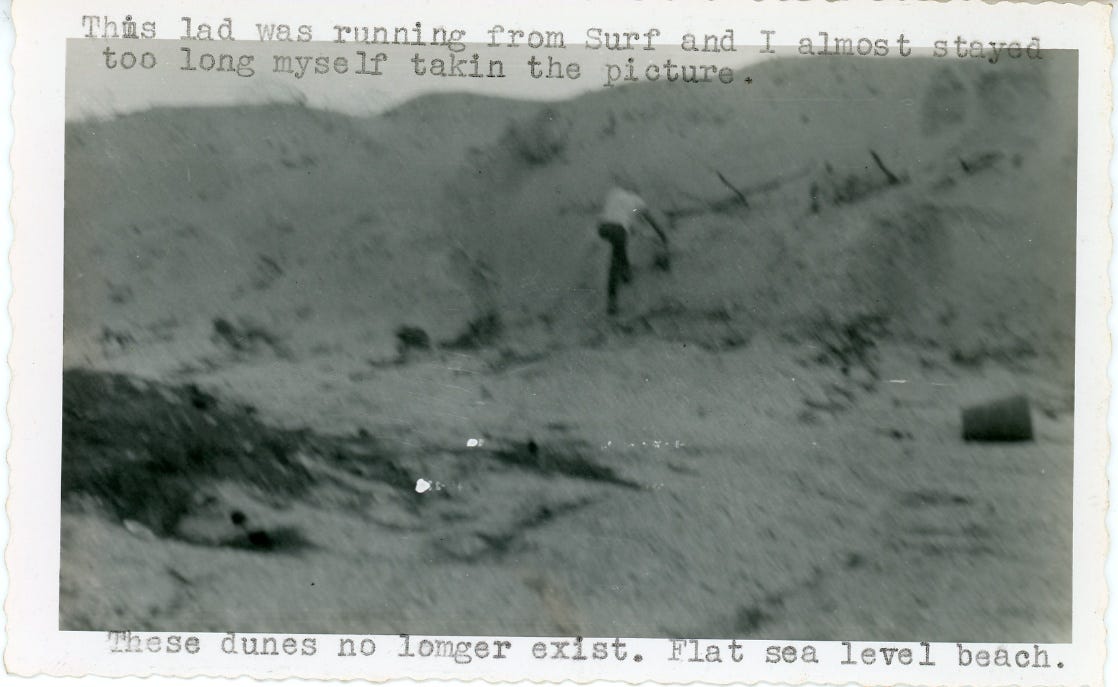
During Hurricane Hazel in 1954, Fred O. Scroggs was in Myrtle Beach, SC. Within a series of photographs from this time, Fred’s accompanying descriptive notes add a grounding thread of personal context. They create a narrative framed by Fred’s own interests and often guide his viewers to examine particular elements in each image. Fred theorized about the cost of the destruction and described the changes in the landscape. Across the top of one photograph, he wrote, “This lad was running from the surf, and I almost stayed too long myself taking the picture. These dunes no longer exist. Flat sea level beach.”
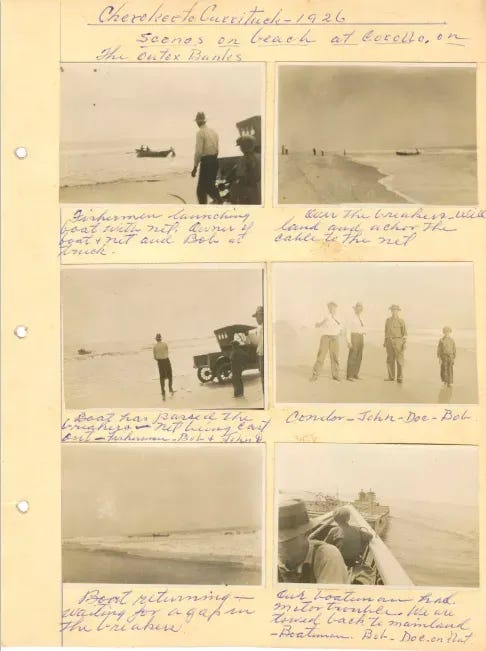
There are instances in the Fred O. Scroggs Collection where a series of photographs allows us to linger slightly longer in a place or a moment. In his family road trip album titled From Cherokee to Currituck, Fred’s photographs occasionally capture tighter temporal sequences. Under a page of photographs taken on the Outer Banks, he wrote brief notes describing a fishing boat launching and returning to shore while the family watched from the beach.
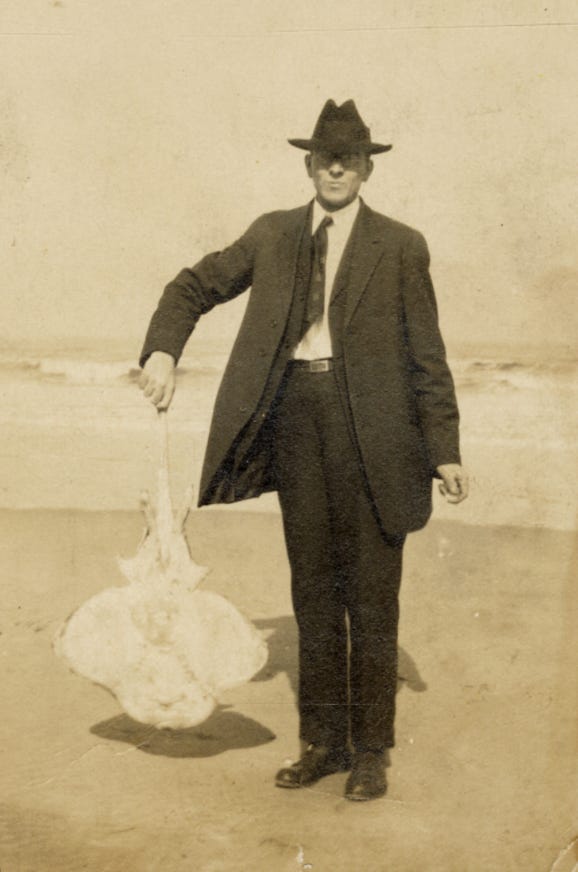
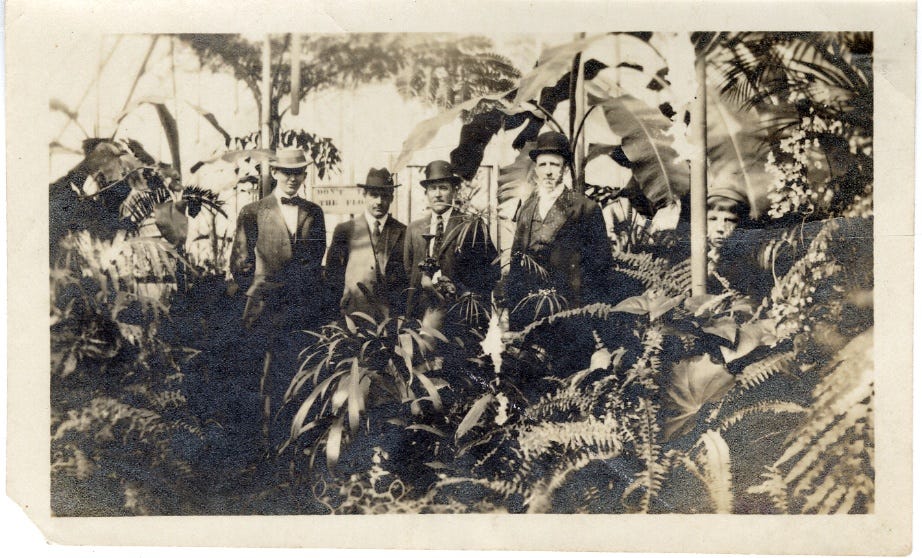

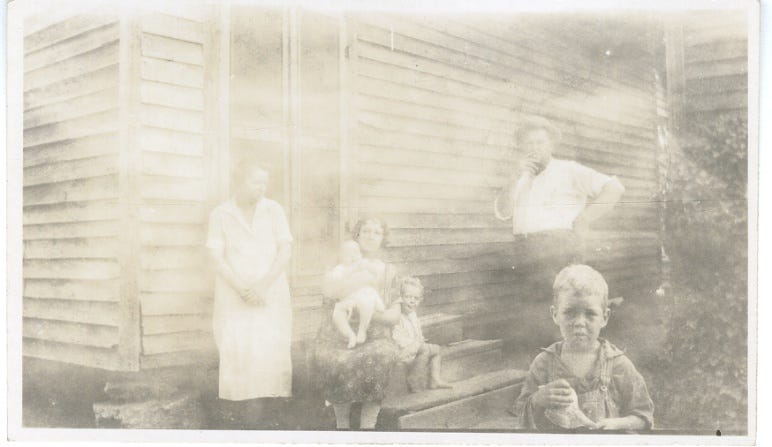
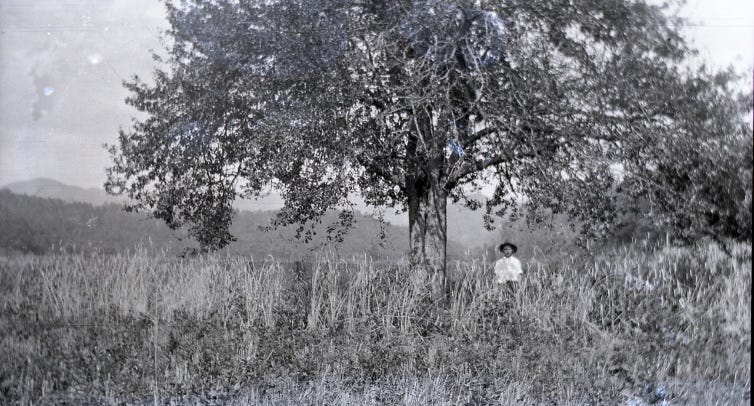
Many of the photographs in the Fred O. Scroggs Collection are mysteries. They don’t clearly belong to a specific place or context; they contain unlabeled subjects or dates. But limited information leaves so much room for imagination and space for us to gravitate to the visual power of the images alone and the open-ended possibilities they offer.
Perhaps a lack of documentation and factual detail can be an entry point for communal storytelling, an opportunity to embrace the gaps in information and sit with the traces of the past that live on in our present. The past is full of potentialities.
Story: Archives work-study student Maya McCollum
Works Consulted and Further Reading:
Hirsch, Marianne. Family Frames: Photography, Narrative, and Postmemory. Cambridge, MA: Harvard University Press, 2016.
Ruchatz, Jens. “Public Rites/Private Memories: Reconciling the Social and Individual in Wedding Photography.” In Global Photographies: Memory – History – Archives, edited by Sissy Helff and Stefanie Michels, 177–204. transcript Verlag, 2018. http://www.jstor.org/stable/j.ctv1wxt5s.13.
Michels, Stefanie. “Re-Framing Photography – Some Thoughts.” In Global Photographies: Memory – History – Archives, edited by Stefanie Michels and Sissy Helff, 9–18. transcript Verlag, 2018. http://www.jstor.org/stable/j.ctv1wxt5s.4.
Parry, Kyle, and Jacob W. Lewis. Ubiquity: Photography’s Multitudes. Leuven: Leuven University Press, 2021. https://dx.doi.org/10.1353/book.98557.